

Living with several missing teeth can affect your ability to chew, speak clearly, and feel comfortable sharing your smile. Tooth loss may also change the way your bite functions and make everyday activities more difficult than they need to be.
Florida Smiles Dental provides custom dentures for patients in Fort Lauderdale and Lighthouse Point, FL. Each restoration is carefully planned around your oral health, facial appearance, bite, lifestyle, and personal goals.
Whether you need to replace several teeth or an entire arch, our dental team can evaluate your smile and explain the available options. Depending on your needs, treatment may involve complete dentures, partial dentures, immediate dentures, or dentures supported by dental implants.
Dentures are removable dental restorations designed to replace missing teeth and surrounding oral tissues. They can restore several teeth in one area or replace all the teeth in the upper jaw, lower jaw, or both.
Modern dentures are individually created to fit the shape of your mouth. The replacement teeth are selected and arranged to support comfortable function while complementing your facial features and smile.
Dentures may help restore:
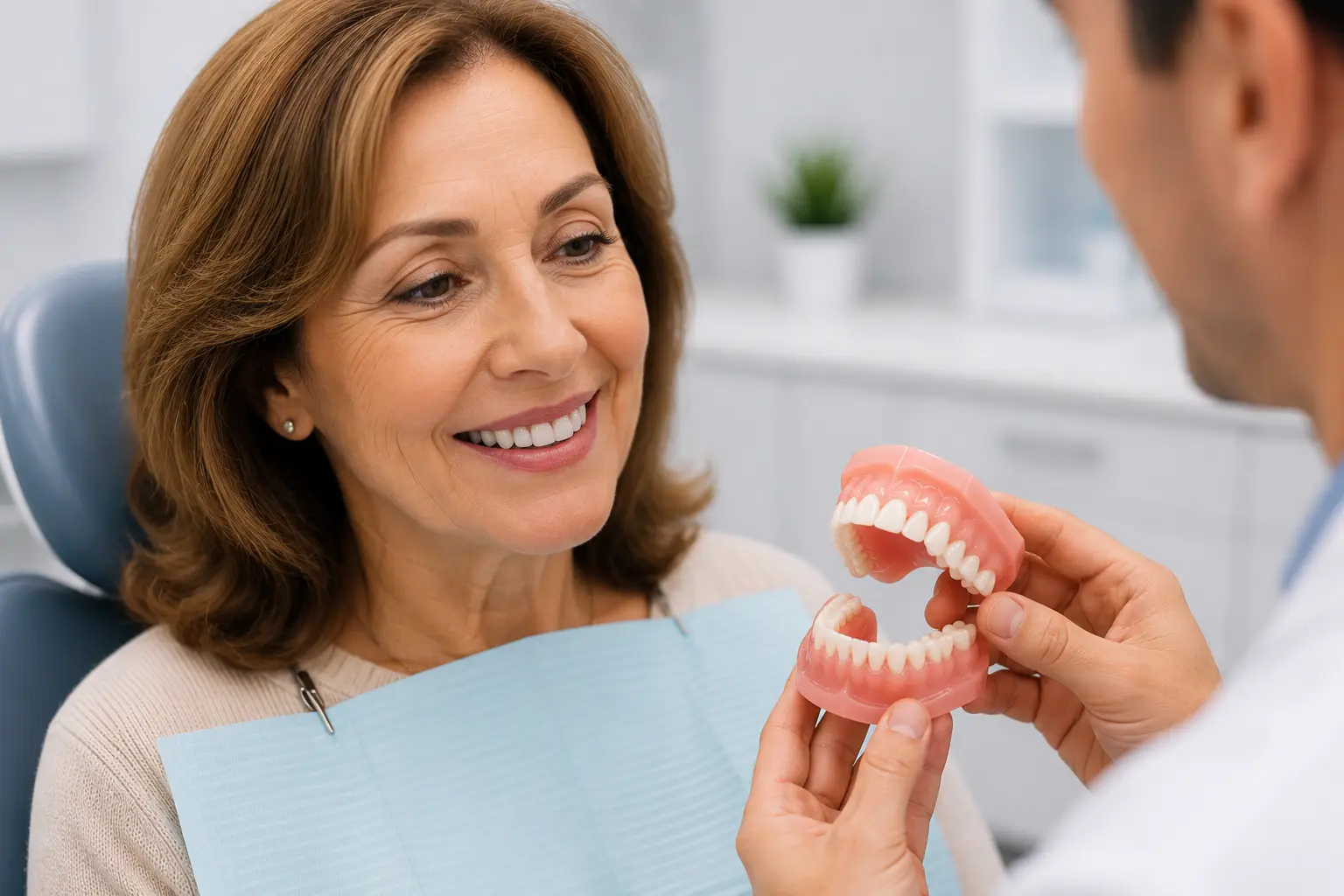
Dentures do not feel exactly the same as natural teeth, and an adjustment period should be expected. However, a carefully planned restoration can significantly improve daily comfort and quality of life.
Dentures may be recommended for adults who have lost multiple teeth because of advanced decay, gum disease, dental trauma, severe tooth wear, or other oral health conditions.
You may benefit from a denture consultation if:
Our dentist will examine your remaining teeth, gums, supporting bone, bite, and medical history before recommending treatment.
Preserving healthy natural teeth is generally preferred whenever possible. If some teeth can be predictably maintained, a partial denture may be more appropriate than removing them for a complete denture.
Different types of dentures are available depending on how many teeth are missing, which teeth remain, and how much support is available.
Complete dentures, also called full dentures, replace all the teeth in the upper or lower arch.
An upper denture generally covers part of the roof of the mouth to improve support and retention. A lower denture is shaped around the tongue and rests on the lower gum and jawbone.
Complete dentures may be recommended when no healthy natural teeth remain in an arch or when the remaining teeth cannot be predictably restored.
Partial dentures replace several missing teeth while allowing healthy natural teeth to remain.
Replacement teeth are attached to a gum-colored base and may be supported by a metal framework, flexible material, dental clasps, precision attachments, or another design selected for the patient.
A partial denture can fill spaces in the smile, improve chewing, and help prevent remaining teeth from shifting into open areas.
Immediate dentures are placed shortly after selected teeth are removed. They allow the patient to avoid going without replacement teeth during the initial healing period.
Because the gums and jawbone change shape after extractions, immediate dentures commonly require adjustments. They may later need to be relined, modified, or replaced after healing is complete.
Immediate treatment must be planned before the teeth are removed so the restoration can be prepared in advance.
Implant-supported dentures attach to dental implants placed in the jawbone. The implants provide greater stability than a conventional removable denture that rests only on the gums.
Depending on the treatment plan, an implant-supported restoration may be removable by the patient or secured in place and removable only by a dental professional.
Potential benefits include:
Implant treatment requires adequate bone, healthy gums, appropriate medical health, and a commitment to consistent oral hygiene.
The main difference between full and partial dentures is the number of natural teeth that remain.
A complete denture replaces every tooth in an arch. A partial denture fills spaces between remaining teeth and uses those teeth or other structures for support.
Our dentist will consider:
The recommended option should restore missing teeth while preserving healthy oral structures whenever practical.
Creating a well-fitting denture involves several clinical and laboratory stages. The exact process depends on the type of restoration and whether teeth must be removed first.
Your first visit includes an evaluation of your teeth, gums, jawbone, bite, and oral tissues.
Digital X-rays or other diagnostic images may be taken to identify infection, bone loss, impacted teeth, or dental problems that cannot be seen during a visual examination.
We will also review your medical history, current medications, previous denture experience, and goals for treatment.
Any active oral health problems should be treated before the final denture is completed.
Preparation may include:
The necessary steps will depend on your individual situation.
Detailed impressions or digital records are taken to capture the shape of your gums, remaining teeth, and supporting structures.
Additional measurements help determine the relationship between the upper and lower jaws, appropriate tooth position, and the amount of facial support needed.
The shade, size, shape, and arrangement of the artificial teeth are selected according to your facial features, age, preferences, remaining teeth, and available space.
The goal is to create a natural-looking smile rather than an appearance that seems overly uniform or artificial.
In many cases, replacement teeth are temporarily arranged in wax before the final denture is processed.
This trial stage allows the dentist to assess:
Adjustments can be made before the final material is completed.
New dentures may initially feel bulky or unfamiliar. The muscles of your lips, cheeks, and tongue need time to adapt to the restoration.
During the first few weeks, you may notice:
Begin with soft foods cut into small pieces. Chew gently on both sides of your mouth to help balance pressure.
Reading aloud can help you practice speaking with the new appliance. Most patients become more comfortable as they gain experience wearing and using their dentures.
Persistent pain, significant movement, sores, or difficulty eating should be evaluated rather than ignored.
A custom denture can provide cosmetic, functional, and personal benefits.
Dentures may help:
Results vary according to oral anatomy, the type of denture, the amount of supporting bone, and the patient’s ability to adapt to the restoration.
Dentures collect plaque, food particles, and bacteria and must be cleaned every day.
To care for a removable denture:
Do not clean dentures with hot or boiling water because heat may distort the material.
Regular toothpaste may be too abrasive for certain denture surfaces. Use products specifically recommended for removable dental appliances.
Most removable dentures should be taken out while sleeping unless your dentist gives you different instructions.
Removing the appliance allows the gum tissues to rest and makes it easier to clean both the denture and your mouth thoroughly.
Wearing dentures continuously may increase irritation and contribute to inflammation or infection beneath the appliance.
Store the denture according to the instructions provided by our dental team so it does not dry out or lose its shape.
Dentures may become loose over time because the gums and jawbone naturally change after tooth loss.
Schedule an evaluation if:
A loose denture should not automatically be repaired with additional adhesive. It may require professional adjustment, relining, rebasing, repair, or replacement.
Traditional dentures and dental implants can both replace missing teeth, but they use different forms of support.
Conventional dentures rest on the gums and are typically removed for cleaning and sleeping. They do not require implant surgery and may have a lower initial cost.
Dental implants are placed within the jawbone and can support individual teeth, bridges, or dentures. Implant-supported restorations generally provide greater stability but require surgery, healing time, and adequate bone.
The best option depends on:
Some patients choose conventional dentures, while others begin with removable dentures and later consider implant support.
Florida Smiles Dental provides comprehensive care for patients who need to replace missing teeth.
Our approach includes:
Every denture is planned according to the patient’s oral anatomy, remaining teeth, bite, appearance, and goals.
Our dental team can evaluate conventional dentures, partial dentures, dental implants, bridges, and other restorative alternatives.
We consider tooth color, shape, arrangement, facial support, speech, comfort, and bite when developing the restoration.
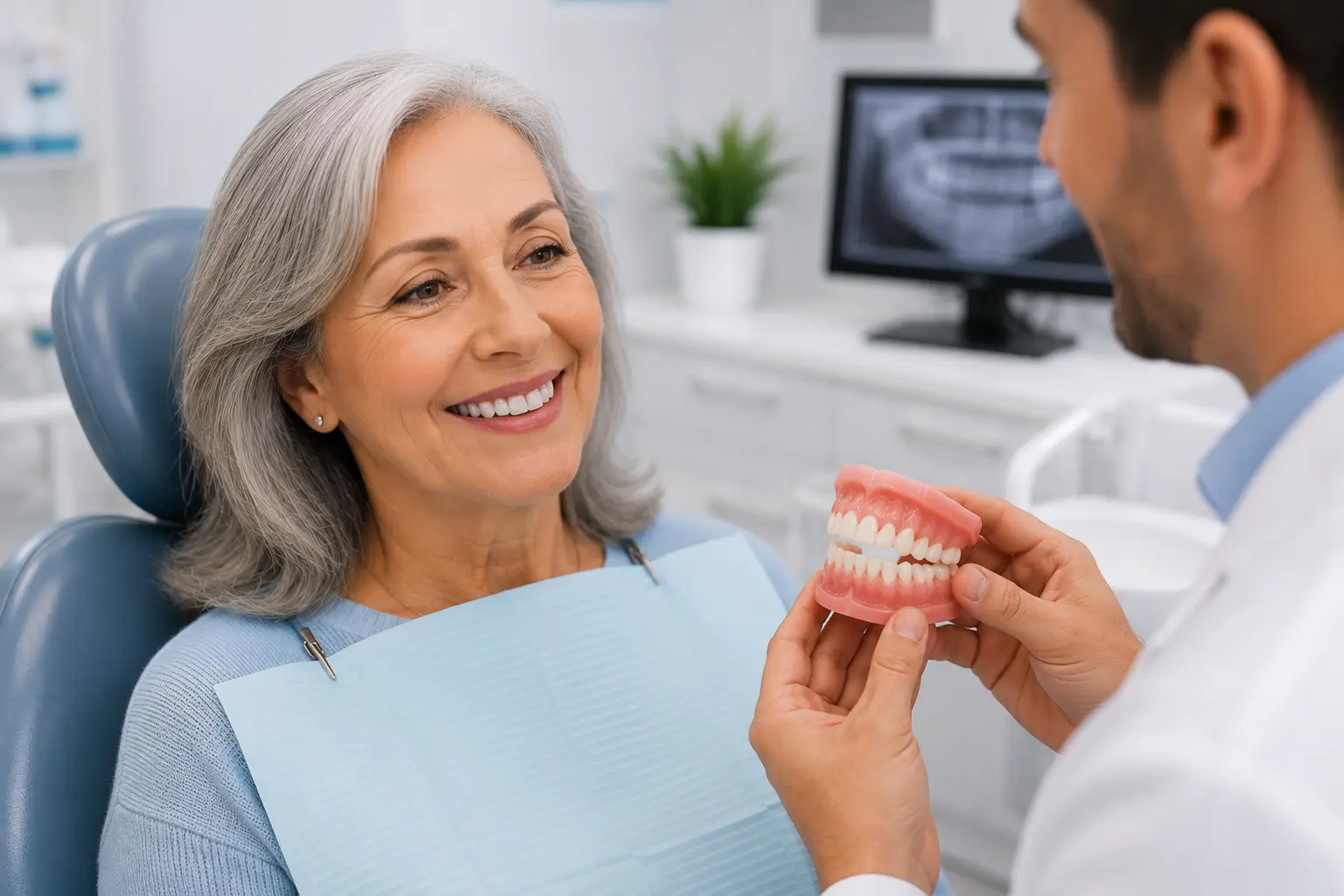
Denture placement is not the end of treatment. Follow-up visits allow us to evaluate sore areas, function, fit, and adaptation.
Patients can receive care at our Fort Lauderdale or Lighthouse Point office.