
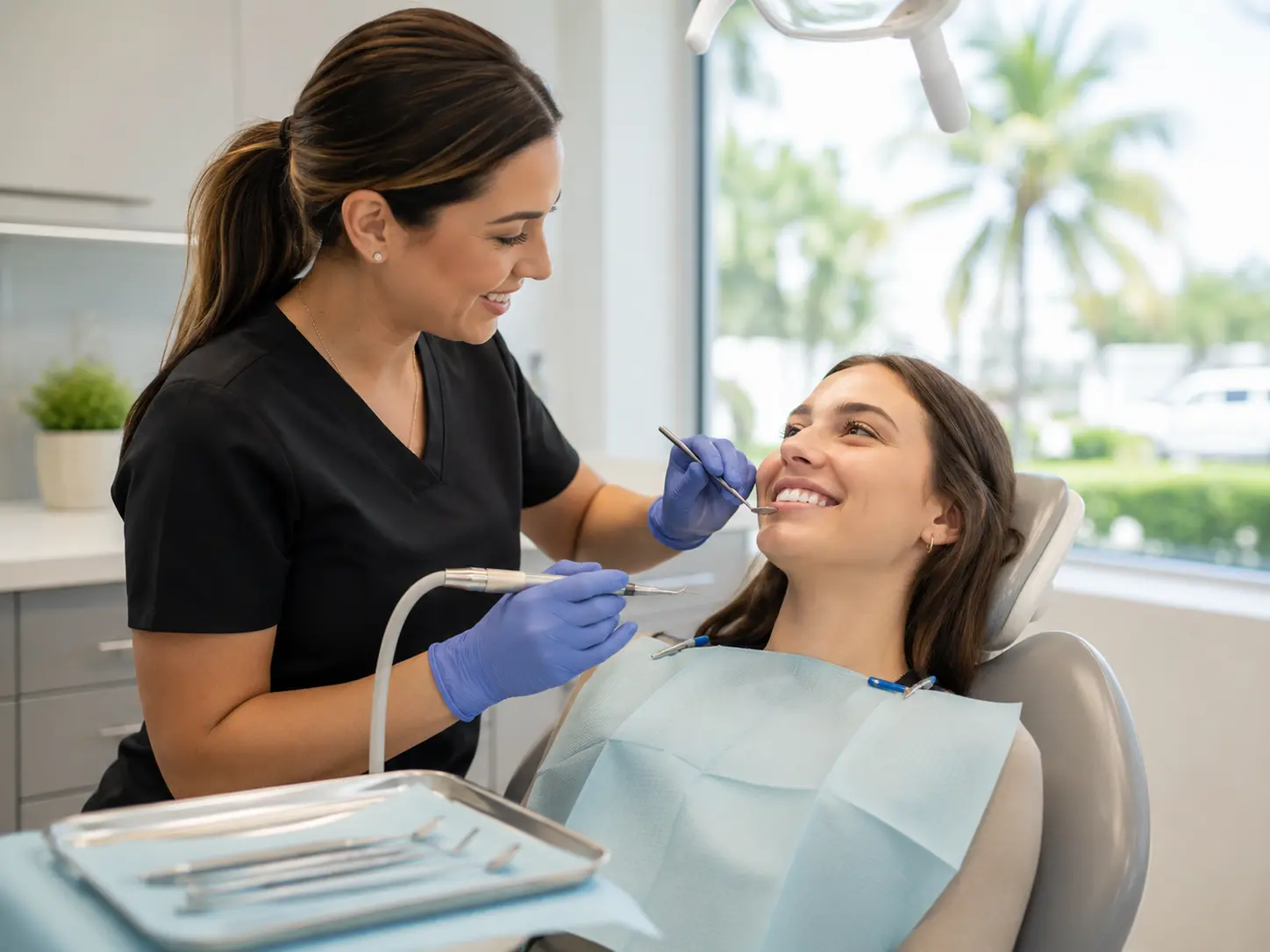
Even with consistent brushing and flossing, plaque can accumulate in areas that are difficult to reach at home. Over time, plaque may harden into tartar, increasing the risk of cavities, gum inflammation, bad breath, and other oral health problems.
Florida Smiles Dental provides professional teeth cleaning in Fort Lauderdale and Lighthouse Point, FL, for children, teenagers, and adults. During your visit, our dental team will evaluate your teeth and gums, remove harmful buildup, polish your smile, and recommend a preventive care schedule based on your individual oral health needs.
Regular dental cleanings help protect more than the appearance of your smile. They also give our team an opportunity to identify early changes before they develop into more complex dental problems.
Contact Florida Smiles Dental to schedule your next dental exam and professional teeth cleaning.
A professional teeth cleaning is a preventive dental service that removes plaque, tartar, and surface stains from the teeth.
Plaque is a sticky film containing bacteria that continuously forms on the teeth. Daily brushing and cleaning between the teeth can remove much of this buildup. However, areas near the gumline, behind the back teeth, and between crowded teeth can be difficult to clean completely.
When plaque remains on the teeth, it can harden into tartar, also called dental calculus. Once tartar forms, it cannot be removed effectively with a regular toothbrush or dental floss. Professional dental instruments are needed to remove it safely.
A routine cleaning may include:

The exact services provided during your appointment depend on your oral health, age, medical history, and the condition of your gums.
Professional teeth cleaning is an important part of preventive dental care. It helps control the buildup that contributes to tooth decay and gum disease.
Regular cleanings can also help our dental team monitor your oral health over time. Small cavities, weakened restorations, gum inflammation, enamel wear, and other changes are often easier to treat when identified early.
Potential benefits of professional teeth cleaning include:
A cleaning does not replace daily oral hygiene. Instead, professional care and good habits at home work together to protect your teeth and gums.
Plaque and tartar are related, but they are not the same.
Plaque is a soft, sticky film that forms on the teeth throughout the day. It contains bacteria that interact with sugars and carbohydrates from foods and beverages.
These bacteria can produce acids that attack tooth enamel. Repeated exposure may eventually contribute to cavities.
Plaque near the gumline can also irritate the gums, causing redness, swelling, or bleeding.
Thorough brushing and cleaning between the teeth can remove plaque before it hardens.
Tartar develops when plaque remains on the teeth and becomes mineralized.
It may appear yellow, tan, brown, or darker depending on its location and exposure to staining substances. Tartar can form above the gumline or beneath it.
Its rough surface can make it easier for additional plaque to accumulate. Because tartar bonds firmly to the tooth, professional instruments are required to remove it.
Trying to scrape tartar from your own teeth can damage the enamel or gums and should be avoided.
Your appointment may include a dental examination, diagnostic records when needed, professional cleaning, and personalized preventive recommendations.
Tell our dental team about changes involving:
Your medical health and medications may affect your gums, saliva production, risk of cavities, bleeding, and recommended dental care.
Before or during the cleaning, we evaluate your mouth for visible signs of dental problems.
This may include checking for:
The depth of the spaces around the teeth may also be measured when necessary to evaluate periodontal health.
Dental X-rays are not necessarily required at every cleaning visit. Their frequency depends on your age, symptoms, dental history, cavity risk, gum health, and previous images.
X-rays may help identify:
Our dental team will determine whether updated images are appropriate for your visit.
Specialized dental instruments are used to remove deposits from the tooth surfaces and around the gumline.
This process is known as scaling. Depending on the amount and location of buildup, hand instruments, ultrasonic instruments, or a combination of techniques may be used.
You may feel light pressure, vibration, or water during the cleaning. Areas with inflammation or sensitivity may feel more tender than healthy areas.
After tartar has been removed, the teeth may be polished with a dental polishing paste.
Polishing helps remove certain surface stains and leaves the teeth feeling smoother. It does not change the natural internal color of the enamel in the same way as professional teeth whitening.
Dental floss or another interdental cleaning method may be used to remove remaining debris between the teeth.
This also allows our team to evaluate areas where floss catches, shreds, or encounters unusual resistance.
Our dental team may demonstrate techniques or recommend products based on your needs.
Recommendations may include:
The most effective routine is one that is safe, thorough, and realistic for you to follow consistently.
A routine teeth cleaning should generally be manageable, although individual sensitivity varies.
You may experience greater tenderness if you have:
Tell our dental team if you are uncomfortable. Adjustments can be made to improve your experience.
If your gums are tender after the cleaning, the discomfort is usually temporary. Contact our office if you experience severe pain, significant swelling, or symptoms that continue to worsen.
The length of an appointment depends on the amount of buildup, the health of your gums, the number of teeth present, and whether an examination or diagnostic imaging is also needed.
A patient who receives regular preventive care may require less time than someone with extensive tartar, multiple restorations, orthodontic appliances, or signs of gum disease.
If periodontal treatment is necessary, the procedure may require additional time or separate appointments.
Many patients receive preventive cleanings approximately every six months. However, the ideal schedule is not identical for everyone.
You may need more frequent professional care if you have:
Some patients with consistently healthy teeth and gums may follow a different schedule recommended by their dentist.
After evaluating your oral health and risk factors, Florida Smiles Dental will recommend an appropriate interval for your examinations and cleanings.
A routine preventive cleaning and a deep cleaning are different procedures used for different conditions.
A routine cleaning, sometimes called dental prophylaxis, is generally intended for patients who do not have active periodontitis.
It focuses primarily on removing plaque, tartar, and surface stains from areas above and around the gumline.
A routine cleaning helps maintain health but is not designed to treat significant infection or deep deposits beneath the gums.
A deep cleaning is commonly known as scaling and root planing. It may be recommended when periodontal disease has created deeper spaces between the gums and teeth.
During treatment, plaque and tartar are removed from above and below the gumline. The root surfaces are cleaned to reduce deposits and help the gum tissue heal more closely around the teeth.
Deep cleaning may:
A routine cleaning cannot substitute for periodontal treatment when deep infection and bone loss are present.
Only a professional evaluation can determine whether scaling and root planing is necessary.
Possible signs of periodontal disease include:
Gum disease may also progress with limited pain. Regular dental examinations are important even when your mouth feels normal.
Gingivitis is the earliest stage of gum disease. It occurs when plaque irritates the gum tissue.
Common signs include red, swollen, tender, or easily bleeding gums.
When no permanent bone loss has occurred, gingivitis can often improve with:
Bleeding gums should not be ignored or treated by avoiding the area. Gentle but thorough cleaning is important, and persistent bleeding should be evaluated professionally.

Patients who have been treated for periodontitis may require periodontal maintenance rather than a standard preventive cleaning.
Periodontal maintenance is intended to control bacterial buildup and monitor areas affected by previous gum disease.
Appointments may include:
These appointments are often recommended more frequently than routine cleanings because periodontal disease can return or continue progressing without consistent management.
Regular dental visits help children become comfortable with preventive care while allowing the dental team to monitor the development of their teeth and jaws.
A child’s cleaning appointment may include:
The approach is adapted to the child’s age, comfort level, and ability to cooperate.
Positive early experiences can help children develop healthier attitudes toward dental care.
Braces create additional areas where food and plaque can become trapped.
Plaque commonly accumulates around:
Patients with braces should continue attending professional cleanings in addition to orthodontic adjustment appointments.
Helpful home-care tools may include:
Cleaning around braces helps reduce the risk of cavities, gum inflammation, and permanent white marks around the brackets.
Dental implants cannot develop cavities, but the gums and bone around them can become inflamed or infected.
Professional maintenance helps monitor:
Implant restorations may require specialized instruments or cleaning methods to avoid damaging their surfaces.
Consistent home care and professional maintenance are essential for protecting the tissues around dental implants.
Hormonal changes during pregnancy may make the gums more sensitive to plaque and more likely to become swollen or bleed.
Maintaining oral health during pregnancy is important. Tell our dental team if you are pregnant or believe you may be pregnant so that your care and any necessary diagnostic procedures can be planned appropriately.
Your visit may include recommendations for managing:
Do not delay evaluation of significant pain, swelling, infection, or bleeding solely because you are pregnant. Our dental team can coordinate care with your medical provider when appropriate.
does not mean preventive care should be avoided.
Before the cleaning, tell our team which teeth or areas are sensitive.
Possible strategies may include:
Tooth sensitivity may result from several causes, including exposed roots, worn enamel, decay, grinding, or damaged restorations. Identifying the cause helps determine the correct treatment.
Professional cleaning can remove some external stains caused by substances such as:
After polishing, your teeth may appear cleaner and brighter.
However, a routine cleaning does not bleach the enamel or change the internal color of the teeth. Patients seeking a more noticeable color change may consider professional teeth whitening after their oral health has been evaluated.
Persistent bad breath may be associated with plaque, tartar, gum inflammation, food trapped between teeth, tongue coating, cavities, dry mouth, tobacco use, or other dental conditions.
A professional cleaning can remove buildup that contributes to odor, but it may not resolve every cause.
If bad breath continues despite good oral hygiene, our dental team may evaluate for:
Maintaining good hydration, cleaning the tongue, brushing twice daily, and cleaning between the teeth can support fresher breath.